
A Glad Heart vs A Gloomy Hammer
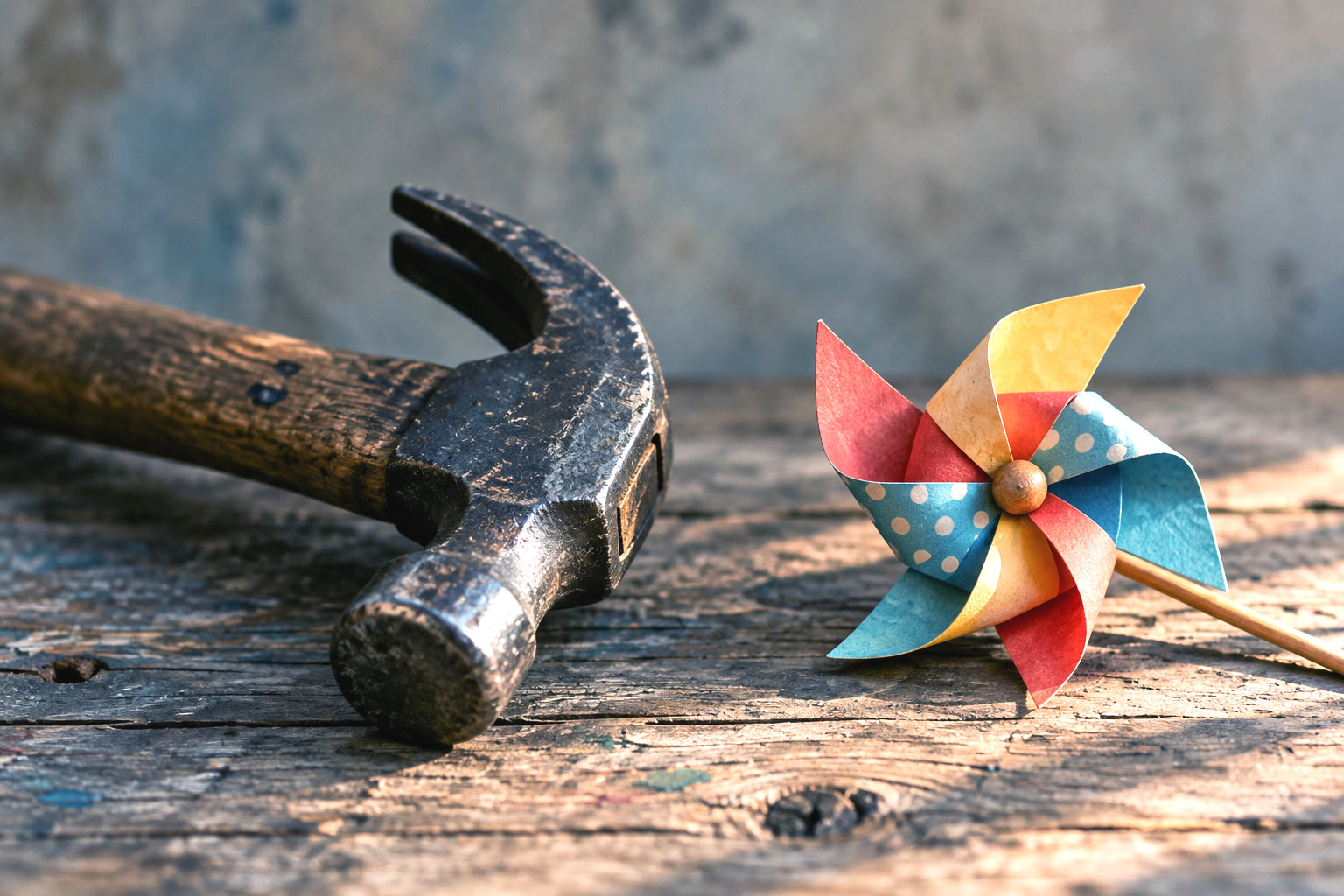
Learning to Play Again
Life’s hammers will keep falling, but must we spend every waking moment bracing for the next blow? What if play, curiosity, and a little purposeful silliness could help us keep going?
Psychology and the self-help industry have a familiar refrain. To avoid complete burnout, we must take time out, relax, or practise self-care. Yet this temporary remedy eventually returns us to a life of constant scrutiny and the pressure to perform, not because we want to but because we must. Long-time readers of this blog will know that it does not advocate escape but bearing up despite life's hammers. Life expects that we should show that we are more able than others and that we engage fully with it according to its preset rules and regiments. These in turn advocate being responsible, productive, and purposeful until we drop.
If play can help, we should first consider what happened to our free time. As our responsibilities accumulated and difficulties demanded our attention, our free time became an exercise in achievement. We persist in obeying our goal-driven mindset, thinking that we are to justify why we are not doing something useful or are wasting time on some frivolous activity. Our weekends acquired a to-do list, and even a walk in the park was logged on a device that would congratulate us on the distance we walked. Even wandering about aimlessly requires supporting documentation, it seems. We see rest as just another task, and we feel guilty when we fail at it.
Our notions about purposeful living have become ubiquitous because we have perfectly logical reasons for not playing. There is work to do, money to earn and a lengthy list of things around the house that need fixing. Even our hobbies have targets, timetables, and expectations. Some of us struggle to remember what we enjoy because there is no one around assessing us. Children play without instruction because nobody has yet taught them how to justify it. This is not a character flaw. Play is a skill like any other, and skills left unused for years tend to feel clumsy when we try them again. Some of us might need a refresher course in messing about.
Play provides us space to explore, experiment, make a mess, follow our curiosity, or do something simply because it makes us happy. Competitive games in which you master a skill are okay, but this is not what this post addresses, unless of course you change the rules of the games just to see what happens. Note the distinction here. A competitive game is controlled by its outcome. There are fixed rules while somebody keeps score, and winning is the goal. On the other hand, free play is governed by the player. We can bend the rules, change the aim of the game midway, and nobody gets to announce a winner. Both types of games have their pleasures. It is, however, only the second one that leaves room for the exploration that this post has in mind. Sadly, playing the second game is lost first.
Uncertainty is easier to tolerate when something interesting pulls us forward, such as curiosity. Curiosity is a great game changer, not only in games but also in real life. What if we followed a question simply because it nagged at us, and then allowed the answer to be entirely useless? Curiosity has no deadline and no line manager. It asks what lives under the flat rock at the bottom of the garden, and it is satisfied with the answer whether it proves useful or not. Curiosity gives us a direction to wander in.
Randomness, however, removes the need to choose a direction. It is another way of breaking free from the reins. We had a family friend who wanted to move away from their adult kids and retire in peace. He found a remote place way across the country furthest away from them, and with little research or even going there to see whether they would like it, packed up, and relocated. Few of us would go to such lengths, but an easier version is available to anyone with a map. For instance, how about spinning a map, sticking a pin into it, recording the GPS, and then go spend the weekend there?
How about going on ridiculous quests like taking a walk in a forest and seeing if you can find any red flowers? Such a quest has no prize and no possibility of failure. If you couldn’t find a red flower, you can claim, quite uselessly, that there are no red flowers there. You haven't failed to meet a target. You went on a relaxing stroll in the forest, and nobody is waiting for your quarterly flower-finding results.
Quests and random pins are but two entries on a list. Play comes in more forms than we usually give credit to. There are games, of the board, card, and backyard varieties, and group activities in which nobody keeps score. We pursue hobbies for their own sake, and free play without a script. Exploring could lead you to a new neighbourhood or an unfamiliar route home. We can experiment with everything. How about making something badly on purpose or trying an activity with no intention of becoming good at it? Then, of course, there is the pleasure of getting together with other people for the sake of their company, with no agenda beyond the conversation and a fun time.
Frequently, play needs a space to arrive in. Boredom and unfilled time can be such a place, which we need to leave open for curiosity rather than filling every spare moment. Most of us treat an empty half-hour as a defect to repair with a screen, a podcast, or a chore. Yet a gap in the day is where a question can occur to us, and where we can notice that we feel like doing something absurd. Fill every gap, and sadly the question never gets its chance.
Through curiosity, experimentation, and doing things with no predetermined outcome, we can actually participate in life instead of merely reacting to what happens to us. Not everything we do has to be a response to a demand. Play cannot remove any underlying difficulty, but it may well help replenish our willingness to keep going. Willingness is a finite resource, and anyone who has run on fumes for a season knows what its absence feels like. Play tops up our fuel in small increments. Or it can be like a car’s suspension taking the edge off a rough road without making the road any smoother. Fun does not defeat adversity. But, adversity does not have to occupy every corner of our lives.
I am not advocating hedonism, life-threatening exploits, or ignoring one's responsibilities. Rather, it’s allowing pleasure to add value instead of treating it as a reward for completed work. We must still pay the bills and feed the family. If pleasure counts only as payment for effort, play will always be one deadline away from being postponed or dropped. If pleasure is allowed to be pleasure for its own sake, life-demands cannot control it when work overruns our lives. We cannot arrange life so that nothing hurts, goes wrong, or demands more than we feel we can give. But we can prevent the difficult things from defining our entire life-experience. Play is another way of being in the world. It’s by being curious, open to surprise, and willing to participate without always knowing the outcome.
Hammers have hit my niece harder than they hit many. She had every reason to collapse under the blows, but she rose up and returned to life every time. She is artistic, witty, fun-filled and laughs easily. Yes, she cries too, but she will be okay, because I think, she knows how to play. (Here’s to you, ‘Wisa!)
The refrain at the start of this post promises that rest will prepare us for more stress, right up until we drop. Those hammers deserve no such attention! The rest of our lives deserve much more. We cannot stop the hammers from falling, but we don’t have to spend every waking moment under them. Play gives us permission to inhabit other parts of our lives, too. So, send this to a friend and invite them to come play.