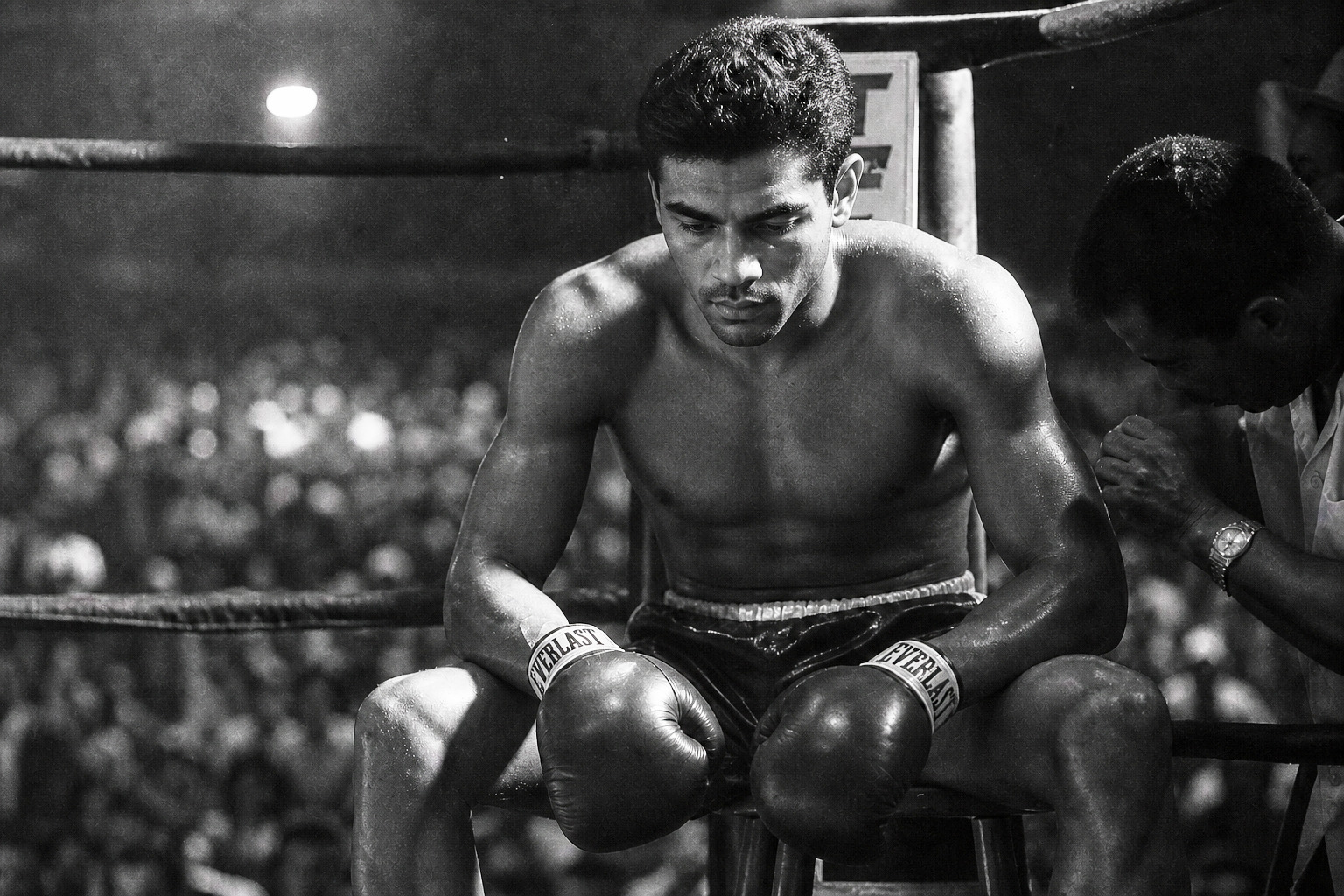
The Weight of Waiting
On how patience forges resilience
A model, the ring girl in high heels and a rehearsed smile, circles the boxing ring with a placard raised above her head. The number announces the coming round, but not what will happen.
Then the announcer’s voice cuts through the air: “Seconds out! Round number three!” Trainers slip through the ropes, the fighters rise, and the bell sounds. Motion, impact, strategy, and survival will determine what comes next. Yet threaded through every punch thrown and every step taken, there is something less visible but equally present: waiting.
Waiting sits quietly inside the spectacle. It is there in the seconds before the bell, in the space between combinations, in the long minute on the stool while a cut is pressed and corner instructions are barked. It is there too at the end, when both fighters stand at the centre of the ring, breathing hard, eyes fixed forward, while the judges’ cards are collected. The arena, moments before thunderous, narrows into a single, suspended instant. The outcome exists. It’s already decided, already written on those scorecards. But it has not yet been spoken. Everyone waits. Even the man who has clearly won.
In this way, the boxing ring becomes more than a theatre of combat. It becomes a contained, ritualised study in disciplined, unavoidable waiting. And as in the boxing ring, so in life. Waiting is not merely an interruption to experience; it is woven into experience itself. To live is to wait — for buses and for diagnoses, for messages and for meaning, for rain, for justice, or for change that seems glacially slow in arriving. Etymologically, “to wait” is to watch, to remain awake, to stay alert. It is an active posture, not a passive collapse. Our language has forgotten this. And in forgetting, we have quietly demoted waiting from a discipline to a nuisance.
Different Weights and Waiting
Like boxing itself, not all waiting belongs to the same weight class. There are the lightweights: the trivial, mildly irritating waits that populate daily life such as standing in a queue, watching the clock before a meeting, or waiting for an overdue meal. These are sparring sessions. They chafe but rarely wound. Then there are the heavyweights: waiting for test results, for a verdict, for a loved one to recover — or not. Waiting for circumstances that seem immovable to shift. These are the championship bouts. They demand endurance, the capacity to absorb sustained punishment without immediate retaliation, and the discipline to stay on your feet when every instinct tells you to sit down.
Boxing regulates its weight classes for good reason: to pit a lightweight against a heavyweight is to invite unnecessary harm. The rules acknowledge limits. In life, we rarely enjoy that courtesy. Waiting often feels like stepping into the ring against something considerably heavier than us, chasing outcomes that outweigh our control, our certainty, and our strength. There is, however, one principle borrowed from the sport worth holding onto: a boxer may choose to fight up a weight class, voluntarily accepting a harder challenge, but never down. Even then, referees intervene if the mismatch threatens real damage. Something in that asymmetry is instructive. We may choose to stretch toward greater difficulty, but we ought not pretend that the difficulty is less than it is, nor demand of ourselves a performance suited to a lighter bout.
Waiting also strikes precisely where boxing strikes: the head, the chest, the breath. Blows in the ring are directed at the face, the jaw, or the solar plexus; the very sites of our vision, balance, cognition, and breath. Waiting targets the same places, though less visibly. It unsettles the mind with looping, unanswerable questions. It presses on the chest, stirring anxiety, hope, fear, and longing in an awkward combination. It tightens the breath, particularly when outcomes feel both significant and uncontrollable. Waiting does not bruise the skin; it marks the interior. And interior bruises, as anyone who has carried one knows, can take considerably longer to heal.
Waiting is particularly punishing, as it strips away the illusion of control. Modern life rewards action: decide, move, fix, respond! Acting gives the impression of progress. On the other hand, waiting demands restraint. When something meaningful is at stake, we cannot push it forward by force. This tension between significance and stillness is acutely uncomfortable; it exposes how much we rely on activity to reassure ourselves that we are not stuck. And yet waiting is not the same as doing nothing. In the corner between rounds, the boxer is far from idle. Breathing is regulated, wounds assessed, and strategy is revised. It is effort without the spectacle and labour with no applause. The crowd sees stillness; the corner sees work.
The distinction matters because waiting can be passive or active. Helplessness and the grinding sense of being trapped by time marks passive waiting. Active waiting involves intention: the deliberate choice to remain observant, to prepare, and to regulate one’s responses. It means resisting the urge to act prematurely, allowing a situation space to develop, and giving one’s own emotions room to settle before deciding anything. From the outside, both forms look identical. Internally, they are worlds apart. One is endurance; the other is training. This is also where waiting begins to function as one of life’s hammers. It forces stillness, and in that stillness, strips away distraction until the questions we have been postponing return with acute insistence. What do I actually want here? What am I afraid of? What am I prepared to do if the answer is not the one I need?
There is one rule in boxing that carries particular resonance beyond the ring. When a fighter is knocked down, or knocked clean out of the ring, no one is allowed to help him back up.
What it Reveals
Waiting also reveals our attachments. We struggle most to wait when the outcome carries the weight of our identity, our security, or our hope. In this sense, the difficulty of a wait is a fairly reliable measure of what we have invested in its resolution. The heavier the attachment, the heavier the wait. And here a particular danger, the temptation of premature action, emerges. Many poor decisions are not born of ignorance but of impatience. The inability to tolerate waiting disguises itself as decisiveness. In boxing terms, it is the reckless swing that leaves one wide open, the impulsive lunge that ignores timing and sacrifices position for the false satisfaction of movement. The punch lands. It counts for nothing. And now you are exposed.
Time itself complicates all of this. In modern life, time has become a form of capital. We speak of saving it, spending it, and wasting it. Thus, waiting feels like haemorrhage, value draining away without visible return. We must, however, contemplate the validity of this carefully. Waiting does not merely consume time; it reveals it. Under ordinary circumstances, time passes unnoticed, absorbed in activity. When we wait, we become acutely aware of its texture. Ten minutes stretch into an eternity; a week can feel like a month. The Greeks usefully distinguished between two kinds of time: Chronos, the measurable kind — minutes, hours, days — and Kairos, the qualitative kind: the opportune moment, the right opening, the time that actually matters. Much of waiting is lived in Chronos, but what we are waiting for is invariably Kairos. Rush, and you risk acting before it arrives. Delay too long, and you risk missing it entirely. Timing, as any good fighter knows, is everything.
There is one rule in boxing that carries particular resonance beyond the ring. When a fighter is knocked down, or knocked clean out of the ring, no one is allowed to help him back up. He must rise on his own. The referee counts. The crowd watches. The corner shouts. But the decision to stand, and the strength to do so, must come entirely from within. Waiting carries the same demand. Others may offer comfort, advice, or distraction. They may stand in your corner, offering encouragement and perspective. But the act of enduring the wait, of staying in the ring, of not quitting, and of not forcing an outcome that is not yet ready, belongs to you alone. It cannot be outsourced, and the fact that it cannot be outsourced is precisely what makes it a hammer.
What it Gives
But waiting does not last forever. Outcomes arrive. Decisions are made. Seasons shift. The moment of suspension resolves, eventually, into motion. We emerge from significant waits altered; sometimes stronger; sometimes more cautious; and sometimes simply more honest about what we want and what we are willing to endure to get it.
Waiting teaches, if we pay attention to it, that it is never merely a gap between events. It is a space for growth. It shapes how we think, how we feel, and how we choose. Perhaps this is the quiet invitation embedded within waiting as one of life’s hammers: not simply to survive it, but to engage with it, to recognise its weight, understand its impact, and decide, deliberately, how we will stand within it. Because in the end, waiting is not optional. But how we wait — that remains, even in stillness, entirely your choice.
Read more on Building the Road Before the Journey