Life as a Potato Salad
On choosing the harder, stranger, and occasionally “wrong” way through life
There’s a quiet seduction in getting things right, as if somewhere a correct version of your life, neatly laid out like instructions on the back of a packet exists. Follow steps one to ten, don’t deviate, and you’ll arrive at something recognisable, acceptable, and, if you’re lucky, approved.
It’s an appealing idea. It promises order in a life that is anything but orderly. It suggests that if things go wrong, it’s because you made the wrong move, chose the wrong path, or failed to apply the right mindset. But there’s a problem with this: life does not behave like instructions. It behaves more like a distracted cook in a half-stocked kitchen, with something burning on the stove and no clear memory of what was supposed to happen next.
Those Rules!
There’s a particular kind of fatigue that doesn’t come from doing too much, but from trying to do everything right; not simply better or good enough, but right. The right decisions, the right mindset, the right level of resilience. Preferably something impressively “anti-fragile” (systems that gain strength, improve, or thrive when exposed to volatility, stress, disorder, and uncertainty) which is not particularly helpful when nothing is working on a Monday morning.
Advice on how to cope, adapt, optimise, recover, endure surrounds us. Entire industries exist to refine our responses to difficulty. And yet, despite all this guidance, life continues to behave like an unsupervised experiment. It’s unpredictable, inconsistent, and occasionally unreasonably hammering. Which makes me wonder whether the problem isn’t that we’re doing things wrong, but that we’re trying too hard to make it right.
Since childhood, the belief that life comes with rules is hammered into us at home, school, and cultural or religious institutions. Don’t get me wrong, certain rules are necessary to protect life and the well-being of society. This is not what I’m referring to here. It’s when rules are rigidly applied to control behaviour in the guise of ‘what’s right or best for everyone.’ However, somewhere along the way, rules became expectations, and expectations became pressure to do the ‘right’ things in the ‘right’ way, as defined by the ‘right’ people—rules and people who want to hammer you into being their ideal. And if you don’t comply or bend, you’re labelled difficult, misguided, or simply a failure.
Let’s be a bit irreverent and ask: what if, instead of handing out rules and expectations, we hand out ‘recipes?’ The word recipe originally meant “take this.” It comes with instructions, but you won’t fail if you don’t follow them exactly. They do not warn you, “Deviate at your peril.” Just, “Take this.” Because life isn’t a super-controlled kitchen. It’s a half-stocked pantry, leftovers in the fridge, a distracted cook, and a stove that occasionally refuses to cooperate or runs out of gas. Is life then not about deciding and improvising?
Improvisation, Ownership, and the Risk of Taste
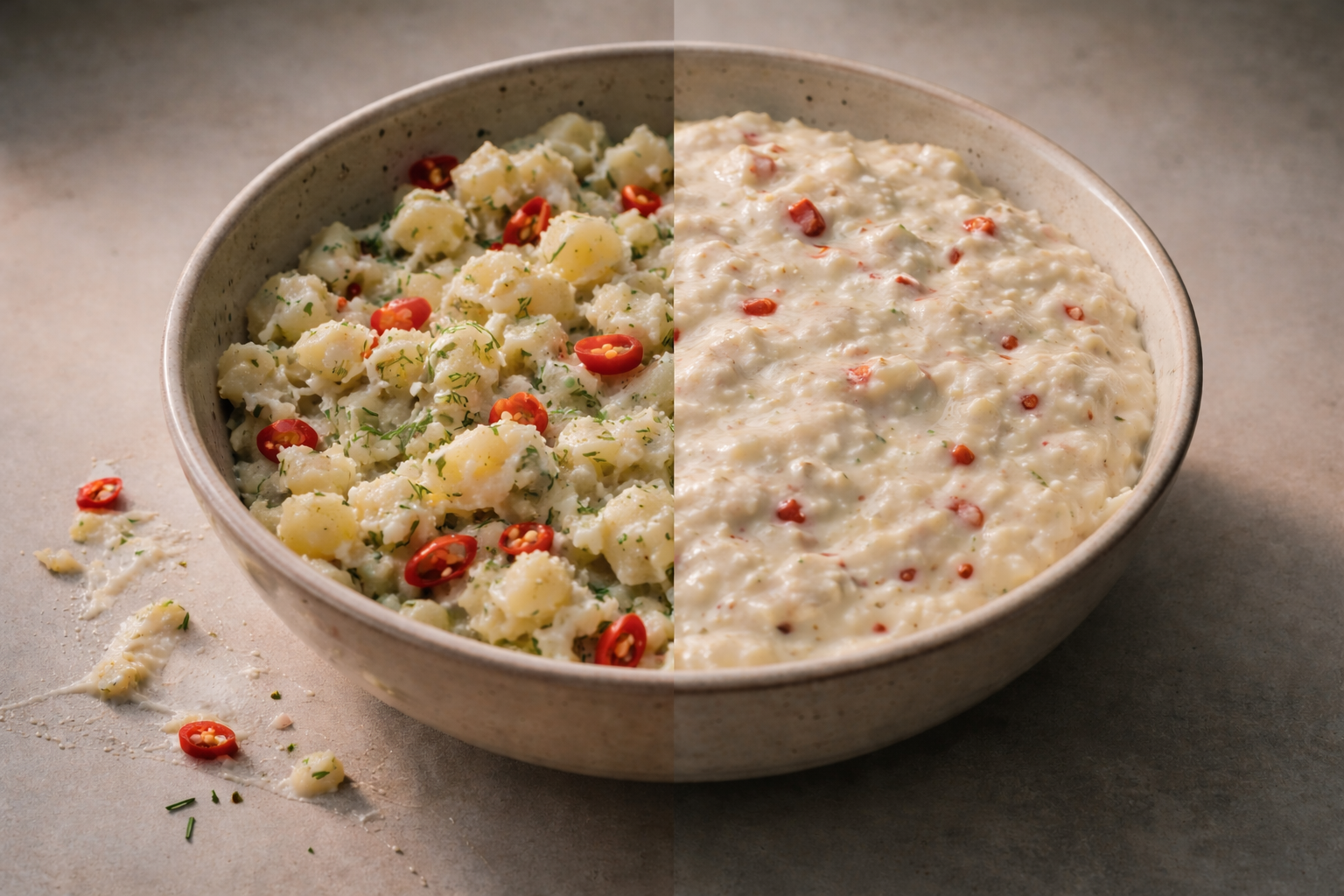
You can make a potato salad the standard way with potatoes, mayonnaise, salt, and pepper. It will be perfectly acceptable and entirely forgettable. Or you can open the fridge and work with what’s actually there. Mustard instead of mayo. Peppers you forgot that you bought. Something slightly aggressive like raw chilli and a spice that only makes sense in that exact moment.
Now it’s no longer an ordinary potato salad. It’s not perfect, not repeatable, possibly questionable, but it’s yours. It carries context and creates memories:
“It was when we had your chilli potato salad that Dad made that joke.”
The difference isn’t in the ingredients. Instead, it’s in the decision to depart from the script. Which raises an uncomfortable point: most of us aren’t short of options. We’re short of willingness to choose differently. Because choosing differently comes with risks. It might not work, taste strange, and be criticised and misunderstood. But it will be genuine.
Friction
Consider friction. We are good at removing it. We have faster systems, smoother processes, and fewer delays. This may be progress, but something subtle changes when life becomes too smooth. Our tolerance for difficulty contracts. Effort begins to feel excessive rather than necessary, and discomfort becomes something to avoid rather than something to engage with. Our minds rest comfortably without realising that, left unchallenged, they become lazy.
According to Canadian ethnographer Richard Kool, the Shushwap tribes of British Columbia lived in a habitat rich in food sources. But the tribal elders noticed something dangerous in this abundance: ease. So, they decided something that by modern standards sounds almost absurd. Every 25–30 years, the entire village would relocate. They would not move out of necessity, but by choice. They’ll discover new terrain, new streams, new game trails, new food sources, and new problems. They chose difficulty. Because without it, life became predictable, and predictability drained it of meaning.
Today, relocating a family simply to reintroduce challenge would be an expensive and inconvenient exercise. But the deeper question lingers: If you had the choice, would you?
Just as you can choose your impromptu salad ingredients, you can choose your life responses. You can’t always choose the circumstances, which arrive uninvited, and often at inconvenient times. But you can choose your stance you take toward them. Most people, however, don’t consciously choose ease. They drift toward it. They follow what is established, approved, and commonly accepted. These are not necessarily better but are seen as being safer. The familiar path is well-lit. The unconventional one is not.
So, we default and optimise to minimise discomfort. We select the option that appears efficient, validated, and unlikely to raise eyebrows. But in doing so, we quietly outsource our decision-making. We stop asking, “What do I want to try?” and start asking, “What is the correct move here?” And those are not the same question.
Choosing the harder path intentionally is not about glorifying struggle. It’s about maintaining agency, deliberately selecting the option that would take more effort, invite uncertainty, may not be understood, and could very well be “wrong” by conventional standards. Because difficulty, when chosen, functions differently. It sharpens awareness, demands engagement, and forces you to participate rather than comply. It builds something that ease cannot: capacity.
The irony is that by avoiding difficulty, we become less capable of handling it. But by strategically and deliberately choosing it, we expand what we can endure, adapt to, and even shape.
The Discipline of Choosing “Wrong”
In creative fields, there’s an unspoken principle: break the rule on purpose. Not for chaos or rebellion, but for contrast. Because something interesting happens when things are slightly off. You notice, question, and remember them. Perfect symmetry disappears into the background; a crack catches the light.
If deviation is acceptable, then “wrongness” stops being a failure and starts becoming a tool. You begin to experiment:
* What happens if I don’t fix this immediately?
* What happens if I take the longer route?
* What happens if I say no when yes is expected?
* What happens if I try something that might not work?
These are not reckless questions. They are generative ones that shift you from passive participant to active author. And yes, sometimes the results will be questionable. Occasionally, it will be a disaster. But occasionally, enough to matter, it will unexpectedly, unmistakably work out. Not correct but yours.
Conclusion
You don’t control the ingredients. That much becomes clear fairly early on. What arrives in your life – circumstances, disruptions, disappointments, opportunities, hammers – is not always curated to your preferences. Some of it is inconvenient. Some of it is unfair. And some of it makes absolutely no sense at the time.
But you are not without influence. You decide what to do with what’s in front of you. You decide whether to follow the recipe or reinterpret it. You decide whether to smooth every edge or leave a few rough ones in place. And, perhaps most importantly, you decide, occasionally deliberately, to choose the option that is harder, less popular, less obvious, and just uncomfortable enough to remind you that you are still paying attention; still alive.
Because a life built only on easy, approved, predictable choices may look right, but rarely feels like yours. So, when expectations, rules, and life’s hammers start knocking you about, you have options. You can comply. You can optimise. You can try once again to get it exactly right.
Or...
... you can open the fridge, take stock of what’s there, and make something that no one quite expected. It may not be perfect or repeatable. It may raise a few eyebrows. Serve it anyway.
And if anyone insists you’ve done it wrong, hand them a spoonful of your unapologetically hot chilli potato salad and tell them, politely but firmly:
“Take this.”
If you liked this, you may also like Life Is Not Easy (2)