Life Is Not easy (2)
First published: 11 June 2025. Updated: 5 February 2026
I ended Part 1 of this two-part blog post with:
"In Part 2 I will discuss being fine with not being fine and being comfortable being uncomfortable despite the hammers ... and until we have grappling hooks to grab hold of hope."
Between those mental states and finding a grappling hook lies the tension of trying to stay well while surrounded by others' ideals, hopes, and needs. This is a personal reflection, not a prescription. I share my experience not to offer universal answers, but to show one way of making sense of the inner landscape we all travel. And to see if we can be fine.
BEING YOURSELF
Measuring our worth only against the hopes and demands of others may blind us to who we really are—and what our deeper capacity and capability is. Expectations of others, although we want to make them proud of us, do not make us who we are. While their expectations and dreams for us matter, they should not overrule our identity and wellbeing. This is not a call to discard communal values or intergenerational bonds. Rather, it's about not erasing oneself in the process of honouring them.
Early in my life, I knew who I did not want to be like. I knew I did not want to do what I saw others do. What I did not know was how to be me against the demands to be something different. For instance, I didn't know it then, but this was my first lesson in how different people shape sounds. I was scolded for not having the 'correct' Dutch [r] and pushed to practise a sound that did not come naturally.
Some Dutch speakers utter the consonant "r" with the tip of the tongue trilling behind the upper teeth (shown as [r] in the International Phonetic Alphabet (IPA)). Others pronounce their "r" from the upper hard palate [ɹ] (as in English) and still others from closer to the throat [ɻ] (as in French). This childhood memory was not linguistically exact, but I was scolded for not having an [r] but an [ɹ] or an [ɻ] and was forced to practice an [r]. I practiced correcting it. But more pressure and derision led to what was perhaps the first time a very skinny little girl refused to bend. I learned about phonetics and the IPA only years later in my study of linguistics. And I must admit, I felt mighty pleased with that very skinny little girl, whose genes made her sound different, and who refused to yield to pressure without knowing why she 'messed up' her "rs." I still have [ɻ] and [ɹ]. I understand that with practice, this can be changed. But I am me, no matter what my "rs" sound like. I am fine. That is what I think.
THINKING
Our thoughts influence the scope of our wellbeing like the gravitational pull of the sun holds Earth in its orbit.
Sometimes, my thoughts are like wild horses—not those depicting nobility, power, or freedom—but those that gallop wildly through the landscape of my mind, taking aim at the horizons of my wits just as I want to write or sleep. My thoughts have caused me more trouble than I care to mention here; troubles that would not exist otherwise.
Now when my wild horses take flight, I ask myself why I was thinking those thoughts. When I think about my thoughts, why I am thinking them, or what caused them to come to mind, the horses slow down. This is referred to as metacognition. It is thinking about our thinking; a mental skill that can be developed and strengthened over time.
Of course, if your thoughts stem from grief, trauma, or the mental exhaustion of chronic illness, this reflection cannot—and does not aim to—replace professional care. Please consider reaching out to a trained counsellor or therapist if the weight feels too great to bear alone.
Briefly, if you find yourself constantly thinking about the same negative thing, ask yourself why you are thinking it. You may find a series of thoughts, one leading deeper into another. Keep at it until you find the original reason that snowballed into negativity. It's not always easy or painless to dig down into negative thoughts. But by keeping at it, you might just tame and stable at least one wild thought.
We all have different definitions of wellbeing, as we have of ill-being. Metacognition does not offer a universal solution. It is like what a pottery teacher would do after giving basic information to students about moulding clay: they would give them a lump of clay and tell them to make it into something fine, of value to them. Thinking about our thoughts is our lump of clay.
Focus especially on the thoughts that drain your mental world—the ones that whirl your beliefs and motives into a spiral of fears.
FEAR
Sometimes we dread even the very word. We fear calamity, sudden danger or attack, ambush, distress, deception, loss of reputation, defeat, material loss, and loss of freedom. At times, we fear those whom we perceive to be more powerful, and in whose presence we comply or cave. These fears, threats, or perceptions can be real, present, and dangerous, or they may not be. But what I found to be very real, present, and dangerous is death. Not literal death.
Death of who I hoped to be.
Death of my me. Death of significance, of belonging, of mattering, of being me. Humiliation, the stripping of dignity, being made small, laughable, undeserving, and powerless reminds me of this kind of death.
I died a few times. "Don't be you, be us." "Don't go that way, take our way." "To be with us you must think and do as we do." And the cutting, idiomatic chant, "In the quiet deep darkness dwells the devil," that followed. I understand that such messages may aim to protect or guide. But when they extinguish individuality rather than nurture it, something essential is lost. They strip away the dignity of being oneself, silence the voice within, and cause harm that takes years to name. So, sometimes I shrank to fit. Sometimes I left to live. Because ...
WHAT MATTERS
... I still had that inner, very skinny little girl refusing to bend. I was wondering how to show you why I thought she remained, when I came across an article by Paul M. Sutter, an astrophysicist[i] explaining that dark matter in space is not entirely empty nor without purpose. From this and other readings, I gathered some (there could be more) parallel meanings between dark/black matter of outer space and the dark hiddenness of our inner space.
· Dark Matter: Invisible yet foundational. Our ‘Inner Matter’: What feels empty inside may be unseen, but it provides unseen structure and potential.
· Dark Matter: Galaxies form and evolve within dark matter halos. Our ‘Inner Matter’: It is the gravitational core from which personal growth, creativity, and connections emerge.
· Dark Matter: Cold and pervasive. Our ‘Inner Matter’: A quiet, steady force, much like inner calm, holds us together, even when it is not obvious.
· Dark Matter: Still has mysteries to be discovered. Our ‘Inner Matter’: Just as physicists strive to uncover dark matter, self-reflection can reveal deep strengths we do not know we have.
What I mean by this is that just as dark matter holds galaxies together even though we cannot see it, our inner lives can have a quiet structure and strength we do not always recognise.
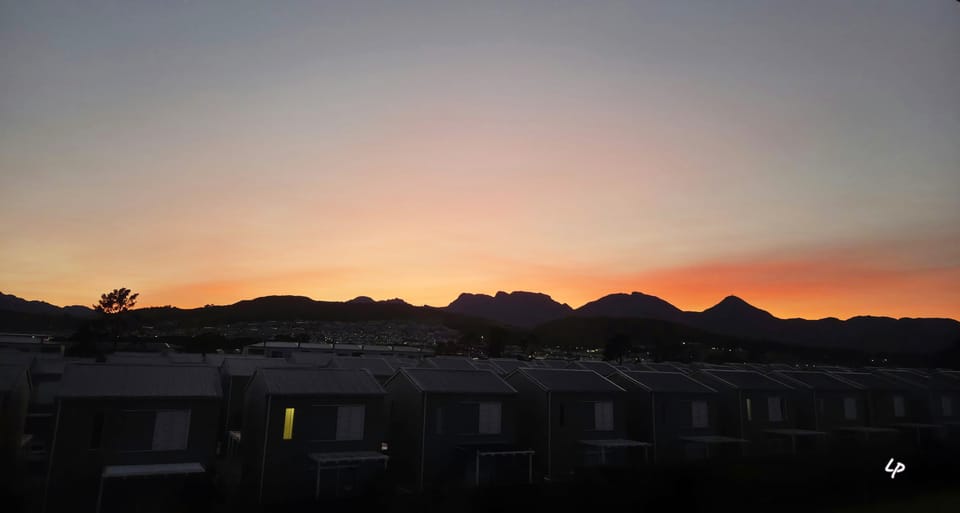
I will leave it to you to derive your own meaning from the shades of the panorama in the photograph above.
A POSSIBLE PICTURE
Possibility says, "It may; it can; it has the potency; it has breath; make a choice; wake up, start over." I know these can sound like slogans. But when the weight lifts just enough, even a small shift feels like a new breath. That is the type of possibility I mean.
Possibility is not what we know for sure. I think that it is how we get to find out; it is having a lump of clay in our hands; or it can be a grappling hook.
If anything in this post does not fit your experience, let it pass like mist before the morning sun, or share it with us. But if something resonates, I hope it helps you find and name your own unseen matter.
Thank you for reading. You can support me in one of the following ways:
Subscribe to the free email newsletter, which allows you to comment on the post. Click the blue button on the top or bottom right of the screen.
Join the Despite the Hammers Channel on WhatsApp to receive notifications of new posts.
Share this post [ https://www.despitethehammers.com/ ] to your social media followers.
Follow my thinking on BlueSky.
Donate any amount via PayPal or directly from your bank.
[i] https://www.space.com/is-the-vacuum-of-space-truly-empty
Member discussion