Connection Is How We Get Back Up
First published: 26 June 2025. Updated: 5 February 2026
I am not a cheerleader. Nor am I overly optimistic, romantic, or idealistic. The gravitational pull of doing things for myself usually anchors my thoughts.
According to my late mother, doing things for myself was something I demanded from an early age. I would bathe, dress, and comb my hair. Walking to school, I did not want a sister holding my hand whilst crossing the street, even though I also did not want to walk alone.
Once, when going to a local café with my sister, I ran ahead on the pavement and ignored her warning about tripping. I fell. She did not stop to help me up but kept walking. I must have sniffled a little, studied my scraped knee, and limped on after her. I was probably glad she was still nearby, even if she did not intervene.
That moment crystallized something I have carried ever since. The hammers of life: our failures, our scraped knees, our hard landings are bearable when we know others are near, even if they do not rush to rescue us. Their presence matters. Their willingness to keep moving forward matters. But the getting up? That is still ours to do.
This is the tension many of us live with. Wanting independence yet needing proximity. Being separate, yet part of a whole.
The Rhythm That Makes Resilience Possible
Life’s challenges arrive whether we are ready or not. Loss, failure, disappointment, and isolation are the hammers that strike without warning. We face them alone, in a sense. No one can grieve for us, heal for us, or rebuild our confidence for us.
But here is what I have learned: our capacity to endure these strikes depends on a rhythm we often overlook. We expand and contract. We gather, then retreat. We practice with teammates and then return to our homes. We attend public events, then step back into private worlds.
This is not dysfunction. This is how resilience is built.
When we remain perpetually isolated, we lose perspective. Our problems consume us. Without mirrors such as other people or other challenges, we cannot see ourselves clearly enough to adapt. But when we remain perpetually connected, we lose the solitude necessary for reflection, for processing, and for integrating what the hammers have taught us.
The rhythm of connection and retreat is not merely about comfort. It is how we discover what we are made of and what role we can play despite the blows we have taken.
Stagnation: When the Rhythm Breaks
In nature, stagnation occurs when life ceases to flow. The result is atrophy and decay. In human life, stagnation happens when the hammers fall and we stop moving altogether.
Consider the animated film Wall-E, where humans live on luxurious space cruisers whilst machines tend to their every need. Over time, their bodies weaken and their minds dull from disuse. The film touches on a truth: when we lose the rhythm of effort and rest, of engagement and retreat, we stop growing. We lose curiosity. We lose the will to exert effort.
This is not laziness. It is the erosion of agency—the very thing we need most when life hammers us.
Stagnation rarely happens overnight. It creeps in when the rhythm breaks. When we over-connect, burning out in forced togetherness, or under-connect, retreating into isolation. Both extremes disrupt our ability to respond to adversity with intelligence and strength.
“Stagnation is not rest. It is the erosion of curiosity, courage, and community.”
Why We Cannot Face the Hammers Alone
When life strikes hard, we often retreat into ourselves. This is natural, even necessary—for a time. But extended isolation becomes dangerous.
Without connection, we have no one to challenge our catastrophic thinking. No one to remind us we have survived before. No one to offer different strategies or fresh perspectives. Worse, we lose the motivation to get back up. Why bother if no one notices? Why rebuild if we are building only for ourselves?
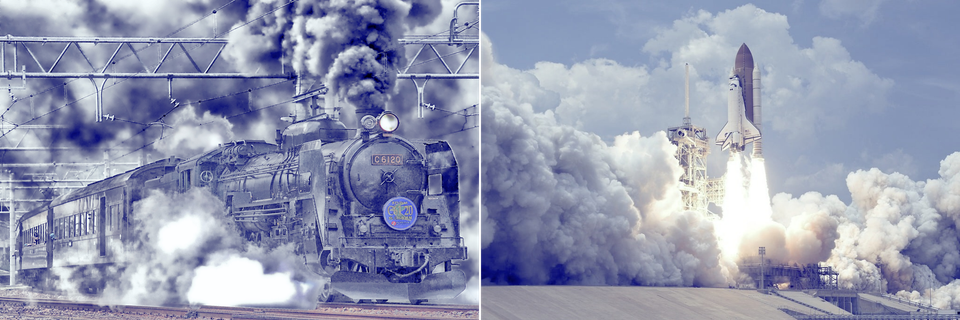
The steam train and the space rocket did not emerge from isolated genius. They emerged from people who specialized in solitude, then coordinated their efforts toward shared goals. The train hauled thousands of tonnes because disparate systems pulled together: cranks, pistons, wheels, tracks, sweat, grit. The rocket broke gravity because math, fuel, risk, and unified intention aligned.
When we face our own hammers such as job loss, illness, betrayal, or failure, we need this same coordination. Not to avoid the blow, but to rise from it. Not to erase the difficulty, but to transform it into forward motion.
What the Rhythm Looks Like in Practice
In my life, I have seen the difference this rhythm makes. As a volunteer in community organizations, I gained experience, knowledge, and social skills. But when I stepped back, initially feeling relieved, I soon began to fret over minor things. I grew disconnected. I stagnated.
The key is intentionality. This rhythm works when we consciously decide to stay connected to something larger than ourselves, even as we honour our need for space. It means showing up when our presence matters, contributing our unique gifts, then stepping back to let others do the same.
This is not about forced optimism or endless availability. It is about cognitive flexibility, which is the ability to hold more than one perspective at a time, especially under stress. It is the discipline of moving between focus and distance, engagement and reflection.
Such flexibility is regenerative. Just as lizards regrow lost tails, those who can adapt and shift their ways of thinking experience renewed resilience. They become capable of recovery, even after rupture.
Join the Rhythm—or Face the Hammers Alone
This is not a sentimental appeal. It is practical.
Life’s hammers will fall. You cannot avoid them. But you can choose how you respond. You can isolate yourself, believing that strength means bearing everything alone. Or you can find your rhythm. Connect. Retreat. Reconnect. So that when the blows come, you have something to return to. Someone to return to.
The choice is not between isolation and constant togetherness. It is between intentional rhythm and aimless drift. Between contributing to something larger than ourselves and stagnating in our separate corners.
Will you find people who can help you get back up—not by rescuing you, but by being present? Will you offer that presence to others?
“We don’t build rockets—or resilient lives—by hiding in a corner.”
The alternative is stagnation. And when the hammers are falling, that is a luxury none of us can afford.
Thank you for reading. You can support me in one of the following ways:
Subscribe to the free email newsletter, which allows you to comment on the post. Click the blue button on the top or bottom right of the screen.
Join the Despite the Hammers Channel on WhatsApp to receive notifications of new posts.
Share this post [ https://www.despitethehammers.com/ ] to your social media followers.
Follow my thinking on BlueSky.
Donate any amount via PayPal or directly from your bank.
Member discussion