
The Madness of Being Measured
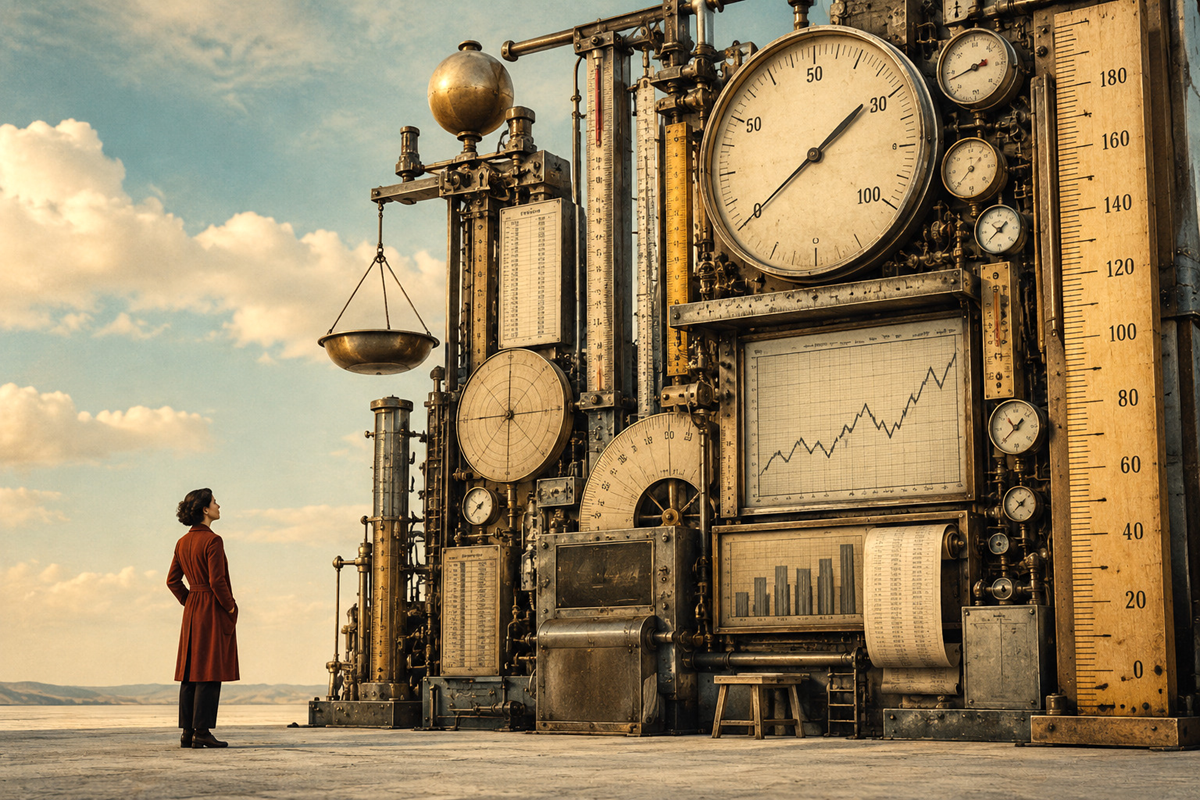
We measure everything. Somewhere along the way, we began allowing the measurements to tell us who we are.
Human beings are messy creatures. We are biological, psychological and social beings who get things wrong, change our minds, have bad days, become ill, fall in love, lose our tempers, recover, fail, succeed and sometimes have absolutely no idea what we are doing. Of course, we try to make sense of all this mess, and one of our favourite ways of doing so is to measure things. Measurement gives us something solid to hold on to in a world that can otherwise seem bewilderingly complicated
Measurement is one of our great intellectual achievements because it helps us understand the physical world, make predictions, solve practical problems, and establish limits and standards. Many of these serve worthwhile purposes. Laws can protect people, medical standards can help identify illness, while social conventions make it possible for communities to function without descending into chaos. The difficulty begins when a useful standard is twisted into a standard for human worth, and it starts cutting reality into pieces.
When Measurement Becomes the Hammer
Apart from the classical definition of the word measure, i.e., to deal out, divide up by measure, ascertain dimensions, quantity, or capacity, the word is also associated with cutting and reducing. This is applicable when we consider what happens when human beings are categorised according to narrow standards. We are different in bodies, minds, abilities, personalities, histories, circumstances, gender, and ways of seeing the world, but we continue to search for a labelled box we can pack people into because a box is easier to handle than the person.
How attractive are you? How young do you look? How much do you earn? How many people follow you? How impressive is your job? How clever are you; how productive, fashionable, influential, politically acceptable are you? Where do you live? These questions come from advertisements, social media, workplaces, institutions, and from each other.
Categories may describe certain characteristics, but it becomes questionable when we allow them to morph our identities or measures of our worth. The hammer lands when somebody else's standard becomes the ruler against which they expect us to measure ourselves. Some expectations are explicit, while others come disguised as entertainment, advice, aspiration, or lifestyle. Of course, there is always something waiting at the end of the measurement for us to either buy, subscribe to, improve, or become.
Who Taught Us to Want Something?
Consider the beauty and fashion industries. There is nothing sinister about making clothes, cosmetics, or products that people enjoy using, with millions of people in the industries where they exercise their creativity. But consider how much of what we believe about ourselves did we actually choose.
Advertising tells us that a product exists. It can also associate a product with an imagined version of ourselves. Social media intensifies the process because we no longer simply look at advertisements; we look at people who live the life we think we should live. To compare ourselves to others produces dissatisfaction that creates a market, and the market neatly offers a solution that we can measure, purchase, and improve.
Marketing influence is not a mastermind sitting behind a curtain. Human attention is influenceable, and businesses have spent years learning how to attract it. Even the physical arrangement of a shop can affect what we encounter before reaching the item we originally came to buy. It’s not that every retailer is manipulating us, but they can nudge our choices without us consciously noticing the nudge and we leave with a full basket instead of the single item we came for.
An Image is Not a Person
Measurement and categorisation can make us think that what we see is something that exists. When we look at another person, we interpret them through whatever information is immediately available to us such as clothing, appearance, accent, occupation, body shape, age, possessions, gender, and behaviour all become pieces of a picture. Yet this is our picture. Our picture is not the person.
When we look at a photograph, we construct an interpretation with no possibility of reciprocity. The person in the photograph cannot correct our assumptions, explain the circumstances, or tell us what happened five minutes before the shutter clicked. We take a complex human being and reduce them to what we can observe from a particular angle at a particular moment.
Social media has made this process quite efficient. A person becomes an image, which becomes a profile, and which then becomes numbers of followers, likes, views, comments, and shares. Eventually, the numbers begin to look like the person. They are not, but numbers have a persuasive way of making things feel certain.
The Tyranny of Optimisation
Numbers’ persuasive quality helps explain our current obsession with optimisation. We can improve anything such as our sleep, bodies, productivity, finances, appearance, careers, social status and even our brain. Online cultures use the language of “maxxing” to describe the measurement and optimisation of certain characteristics we must pursue for a better life or greater social standing.
The appeal is understandable because life is uncertain, while measurement promises control. If I can identify the problem, measure it and optimise it, I could make life behave. Yeah? Life is not a machine assembled from replaceable components, and human circumstances do not produce the clean cause-and-effect relationships that maxxing promises.
The unemployed person must improve the CV, expand the network, polish the personal brand, and practise the interview. The ill person must fight harder. A child's difficulties are parental failure. In each case, a confounding system becomes the responsibility of one individual–and then the hammer lands on one who may be least able to change the circumstances of the problem. Measurement has then ceased to illuminate the situation and has become a way of assigning responsibility or blame.
The Instrument Cannot Become the Thing it Measures
A thermometer measures temperature; it does not make the room hotter or colder just like a measuring tape tells us how long something is; it does not change the object's length simply because we have measured it. The instrument reports, and we must decide what the report means.
A test score tells us how someone performed on a particular test, but it cannot transform that performance into a complete description of the person's potential. A bank balance tells us how much money is available, but it cannot measure generosity. A qualification tells us that someone completed a particular course of study, but it cannot measure wisdom.
Measurement becomes insidious when we move from allowing it to tell us something about another, to telling us who the person is. This linguistic movement swings a large hammer because it turns a description into a judgement and an identity.
The Approval Trap
Human beings want recognition and to be respected, valued and acknowledged by others. We are social creatures and our belonging matters to us. But the desire for recognition becomes a competition in which everyone is simultaneously measured by everyone else. We compare ourselves to others, while followers become evidence of influence and likes are the evidence of approval. A number that began as a measurement becomes a proxy for worth.
Writers can fall into the same trap. Someone may begin writing because an idea matters, then gradually start writing what they believe their readers want to read. The audience has become the measuring instrument, and the writer begins adjusting the writing according to numbers recorded in the website metrics. The same thing happens in less visible ways when we edit ourselves according to anticipated reactions, say what others will approve, hide what others will criticise or purchase whatever signals the identity we want others to see. The hammer comes down painfully when we eventually find ourselves living according to measurements we never consciously chose, and we don’t like who we became.
Swimming with the Current
There is an old saying that only dead fish flow with the current. It captures the ease with which social expectations can carry us along. A current is powerful precisely because it does not require us to make any decisions, but simply drift along.
Everybody is doing it, wants this, and knows what success looks like. Everybody agrees that you should be thinner, richer, younger, and more productive, attractive, successful, connected, informed, outraged, or more whatever the current demand happens-to-be. However, widespread agreement does mean that an opinion is reality. The judgement of someone deciding that you are unsuccessful is not an objective fact. Other people's opinions are information about their opinions; they are not information about you.
Our Most Useful Rebellion May be Cognitive
I am not suggesting that we throw every standard into the nearest river. The issue is what we do with the information once we have it. When confronted with a measurement, questioning it ought to be our first response. Who decided that this was worth measuring? What does the measurement actually measure? What was left out? Who benefits if I accept the measurement as important? What behaviour does it encourage? What happens if I refuse to make this measurement the measure of myself?
This is not being paranoid, but asking questions is necessary when we must protect something valuable: our capacity to think before somebody else has finished thinking for us. Question everything, because the more sophisticated a hammer becomes, the less obvious the blow may be.
We are More Than the Measuring Instrument
Our most important qualities are hard to measure. Relationships live between people. Trust develops over time. Courage appears in circumstances and wisdom accumulates through experience. Love cannot be reduced to a score nor can grief, loyalty, imagination, humour, or the decision to keep going when nobody is watching.
These qualities exist in the connections between events, people, and experiences; things that are relational, contextual, and messy. In other words, inconveniently human, which may be why we keep trying to reduce ourselves to numbers and categories. Numbers give us the comforting impression that we have finally laid hold of something solid.
But a measurement remains a mere measurement. Your height is not you, nor is your age, salary, qualifications, followers, appearance, nor where you live and work. Somebody else's opinion of you is most certainly not you. Each opinion may say something, but none covers the whole of a human being.
The hammer falls when we forget that distinction. It falls when a description or category becomes a judgement or an identity. It falls when a standard becomes a demand and when somebody else's idea of the ideal becomes the blueprint for our lives. We are not precision-engineered according to another’s technical drawings. Trying to live as though we are, causes unmedicinable grief and heartbreak.
When the next hammer arrives with a ruler, a ranking, a score, or an idealised picture of who we ought to be, we should pause before allowing it to strike. We might look at the measurement, consider what it says and then decide for ourselves how much authority it deserves or what permission we give it to label and box us and control who we are.
An apt response could be, “You! You who built an enormous machine to measure me. Really? Are your measurements all you have? You still don't know, own or control who I am.”
Further reading: Words can be hammers too And A Basket of Fruit in a World Full of Hammers